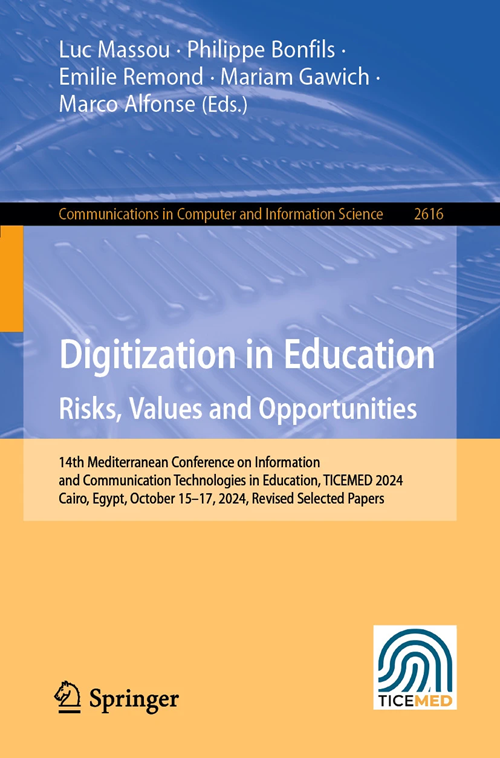
Digitization in Education Risks, Values and Opportunities (Ticemed 14)

This book constitutes the refereed proceedings from the 14th Mediterranean Conference on Information and Communication Technologies in Education, TICEMED 2024, held in Cairo, Egypt, in October 15-17, 2024.
The 15 full papers presented in this book were carefully selected and reviewed from 42 submissions. These papers have been organized in the following topical sections:
- AI integration in Pedagogy: Ethical and Critical Challenges
- Digital Technologies in Education and Learners' Perspectives
- Hybridization and Learning Experiences
Generative AI in Design Education: Pedagogical Uses and Critical Thinking
Aymeric Bouchereau
Pages 3-16
The Pedagogical and Ethical Challenges of Using Generative AI as an Educational Resource: The Case of SEO Training
Jean-Claude Domenget, Clémentine Fruchard Muller, Sylvain Sagot
Pages 17-29
Digital Literacy as an Asset in Teaching GenAI for Communication Students? A Reversed-Teaching Case Study
Laurent Collet, Michel Durampart, Carsten Wilhelm
Pages 30-44
ProfFîlos: AI Approach for Automated Assessment of Student Translations from English to Arabic
Mariam Gawich, Sarah Abouelenine, Marco Alfonse
Pages 45-57
The Adoption of AI at the University of Mauritius. Performance, Tutor Support and Interaction
Gundeea Narrainen
Pages 58-76
Beyond Uncertainty: AI Anxiety from the Perspectives of Students and Professors on Job Replacement
Sinem Boyraz
Pages 77-88
Digital Technologies in Education and Learners’ Perspectives
Front Matter
Pages 89-89
“Learning Paradise”: What Kind of Training Do Students Dream of for the Future?
Vanessa Marescot, Sylvie Leleu-MervielPages 91-109
Advances and Limits of Inclusive University Education Through Technologies
Mohammed Zaki Lhasnaoui, Fathallah Daghmi, Farid Toumi, Hamza El Hanine
Pages 110-122
Digital Mediation and Resilience: Issues and Practices for Secure Digital Education
Ikram Mazroui, Nadia Chafiq
Pages 123-138
Autodidaxia in Learning Music: Musical Exchange and Formalization of Knowledge
Hervé Zénouda, Radhika Khanna
Pages 139-151
Micro-credentials in Public Higher Education: Digital Technology Serving Mass Individualization
Baptiste Doucey
Pages 152-163
Hybridization and Learning Experiences
Front Matter
Pages 165-165
Learning Experience in Hybrid Environments: Towards the Identification of Evaluation Criteria
Laëtitia Pierrot, Paola Cornejo Costa, Melina Solari Landa
Pages 167-179
Blended Learning Opportunities for Personalized Learning in Multi-Level Classroom
Paul Pouzergues
Pages 180-195
The Effect of Implementing Flipped Learning, as a Critical Thinking Approach, in EFL Classes on Improving Speaking Skills in Mount Lebanon
Dima Abdel Samad, Nathalie Rouphael
Pages 196-213
Evaluation of a Practical Work Hybridization Experiment: Case Study of the Biophysics Module
Salma Aimara, Mohamed Radid, Ghizlane Chemsi, Mohamed Moussetad
Pages 214-226